
143 Points and a 30-Point Loss: The Night Denver's 1990 Nuggets Ran Into History — Where Are They Now?

Nuggets History: November 10, 1990
Most nights, 143 points wins you a basketball game. Most nights, it wins by 20.
On November 10, 1990, at Arizona Veterans Memorial Coliseum in Phoenix, the Denver Nuggets scored 143 points and lost by 30.
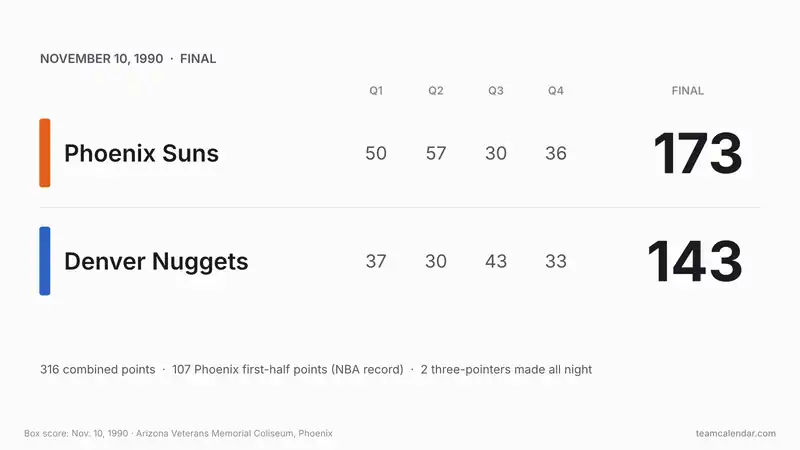
The Suns won 173–143. Phoenix's 173 is still the most points in franchise history and tied for the most ever scored in a regulation NBA game. Denver had to look at all of it from the other side.
This is the story of that night from the Nuggets' bench: a team that scored 143 and won the second half, playing the second night of a back-to-back, inside the most extreme experiment in NBA history.
The System: Westhead's Full-Speed Nuggets
Paul Westhead arrived in Denver in 1990 with a championship ring from the 1980 Lakers and a philosophy he'd perfected at Loyola Marymount: shoot within seconds, press all game, and run the other team into the floor. His LMU teams had led the nation in scoring. In Denver he got to try it in the NBA with a roster rebuilt almost from scratch.
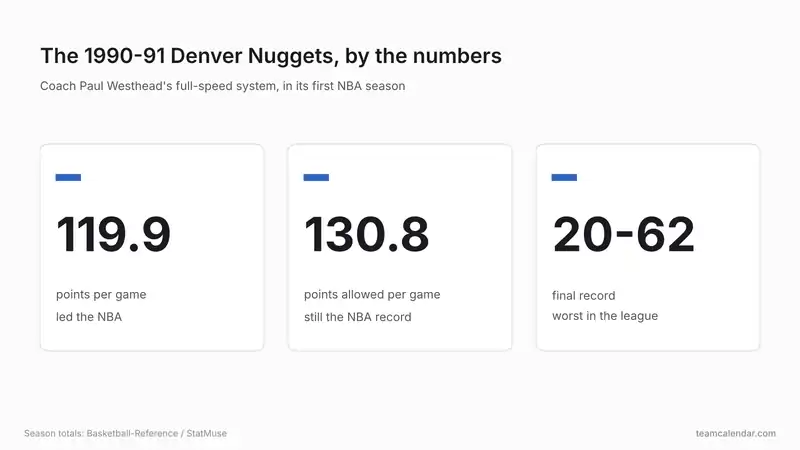
The results were historic in both directions. The 1990-91 Nuggets led the NBA at 119.9 points per game. They also allowed 130.8 per game, which is still the NBA record. They lost their first seven games and finished 20–62.
They'd also just set a record that lasted three days. On November 7 at San Antonio, Denver led the Spurs 90–83 at halftime, the most first-half points by an NBA team at the time. They lost that game 161–153. Then they came to Phoenix and ran into a team that could play their game better than they could.
Denver arrived in Phoenix on a back-to-back, having played Seattle at home the night before.
How 143 Becomes a 30-Point Loss
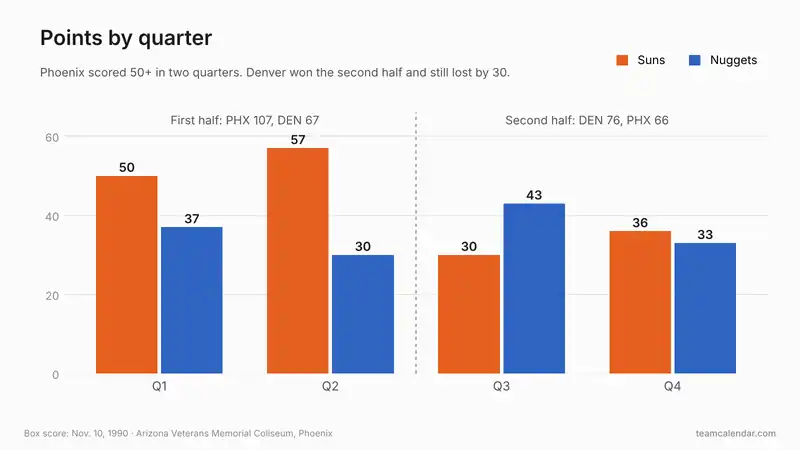
Denver scored 37 in the first quarter. That's a great quarter. Phoenix scored 50.
Then the second quarter happened. The Suns scored 57, tying for the second-highest quarter in NBA history, and went into halftime with 107 points, which is still the NBA record for a half. Denver had 67, and the two teams had combined for 174 before halftime, a mark that still stands.
Here's the part Nuggets fans should remember: Denver won the second half, 76–66. The Nuggets outscored Phoenix by 13 in the third quarter and kept coming. It just couldn't touch a 40-point halftime hole.
The other numbers explain it. Phoenix shot 64.4% and handed out 50 assists. Denver shot 46% on 117 attempts and turned it over 25 times. In Westhead's system, every turnover meant another layup the other way.
The Only Threes of the Night
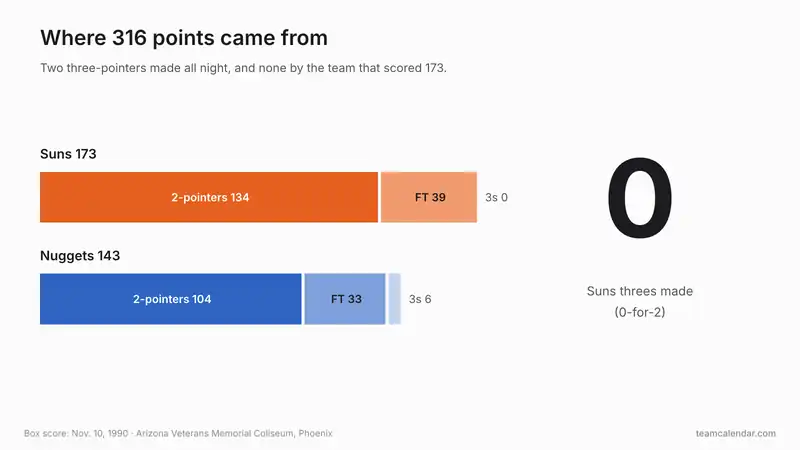
One of the strangest facts about the highest-scoring game in Suns history: the only three-pointers made all night were Denver's. The Nuggets went 2-for-7 from deep for six points. The Suns, on their way to 173, went 0-for-2.
Denver's 143 broke down like this:
- 104 points on two-pointers
- 33 points at the free-throw line: 33-of-41
- 6 points from three: 2-of-7
In a league where teams now take 40 threes a night, both teams combined to take nine.
Every Point of the 143
Westhead played eleven men. Ten scored, and Orlando Woolridge alone scored more than a quarter of the team's points.
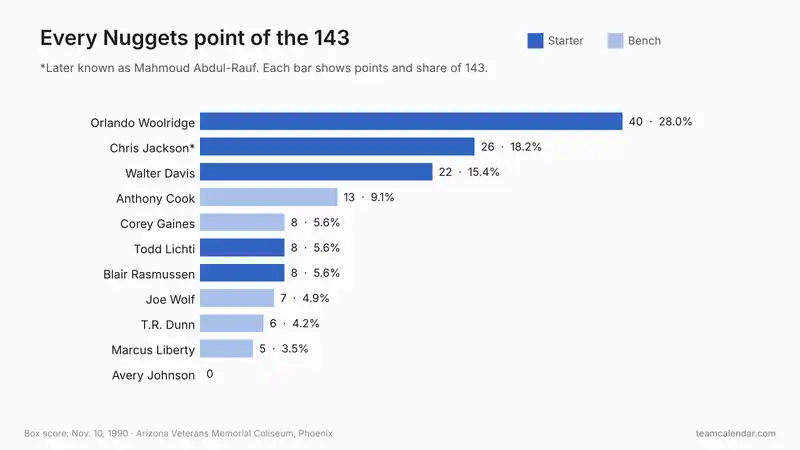
So where did the men who scored them end up? Let's catch up.
The Starters
Orlando Woolridge: 40 of the 143 (28.0%)
40 points on 14-of-24 shooting and 12-of-13 at the line. On a night when no Sun scored more than 32, the best individual performance in the building belonged to Denver. Woolridge was a high-flying Notre Dame forward who had already starred for the Bulls, Nets and Lakers, and he was in the middle of a 25-point-a-game season in Westhead's system. A few weeks later he needed surgery for a detached retina, and Denver traded him to Detroit after the season. He later played overseas and went into coaching, including a stint leading the WNBA's Los Angeles Sparks. Woolridge died on May 31, 2012, at 52, from heart disease. His 40 in Phoenix is a reminder of how good he was.
Chris Jackson (Mahmoud Abdul-Rauf): 26 of the 143 (18.2%)
26 points in just 25 minutes. This was a rookie, the No. 3 overall pick out of LSU, and he was a flamethrower. Chris Jackson changed his name to Mahmoud Abdul-Rauf in 1993, won the NBA's Most Improved Player award that season, and became one of the best pure shooters of his era and one of the best free-throw shooters in league history. In 1996 his decision not to stand for the national anthem led to a league suspension and became a national story that's been revisited many times since. He kept playing into his 50s, suiting up in the BIG3 through 2022. His life is the subject of the 2022 Showtime documentary Stand, and he has written a memoir, In the Blink of an Eye.
Walter Davis: 22 of the 143 (15.4%)
22 points and 4 steals, in the building where he became a legend. Here's the twist that makes this game so strange: one of Denver's best players that night was the greatest scorer in Suns history. "The Greyhound" spent 11 seasons in Phoenix, made six All-Star teams and was the franchise's all-time leading scorer for more than three decades. Devin Booker finally passed him in 2025. Davis had signed with Denver in 1988, so on this night the Suns crowd watched him pour in 22 against his old team. Phoenix retired his No. 6 in 1994 and put him in the Ring of Honor in 2004. After his playing days he worked as a Nuggets broadcaster. Davis died on November 2, 2023, at 69. His nephew, Hubert Davis, is the head coach at North Carolina.
Blair Rasmussen: 8 of the 143 (5.6%)
8 points and 9 rebounds. The 7-foot center from Oregon was in the best season of his career in 1990-91, in the most chaotic system the league had ever seen. He spent two more seasons with the Atlanta Hawks before retiring and settled in the Seattle area, where he coached girls' basketball at Mercer Island High School. Rasmussen is in the University of Oregon Athletics Hall of Fame (2002) and the Pac-10 Hall of Honor.
Todd Lichti: 8 of the 143 (5.6%)
8 points on 3-of-15 shooting. Not his night. But Lichti was a big-time scorer: he left Stanford as the school's all-time leading scorer, a record that stood until 2015, and went into the College Basketball Hall of Fame in 2019. Knee injuries derailed his NBA career, and he finished his playing days overseas with Australia's Perth Wildcats.
The Bench
Anthony Cook: 13 of the 143 (9.1%)
13 points, 9 rebounds and 4 blocks in only 9 minutes. Per minute, Cook may have been the most productive player in the game. And he has one of the best ties to this night: the Arizona Wildcat was drafted by the Suns with the 24th pick in 1989 and traded on draft night in the deal that brought Kenny Battle to Phoenix. Both players scored in this game. Cook played in Greece before joining Denver and later bounced between the NBA and overseas leagues. We couldn't confirm where he is today. If you know, we'd love to hear from you.
Corey Gaines: 8 of the 143 (5.6%)
8 points: 1-of-1 from the field, and that one was a three, plus 5-of-6 at the line. Gaines hit one of the only two three-pointers in the entire game. He'd played for Westhead at Loyola Marymount and followed his coach's system into the pros. Later, he followed Westhead to the WNBA's Phoenix Mercury as an assistant on the 2007 title team, then took over as head coach and won the 2009 WNBA championship himself. He coached on the Suns' bench under Jeff Hornacek, who was on the other team that night, then worked as an assistant with the Knicks and Wizards. He has since been coaching with Japan's national basketball program.
Joe Wolf: 7 of the 143 (4.9%)
7 points. The former North Carolina captain was a versatile big man who had a long NBA career with several teams, then spent decades coaching in the G League, college and high school ranks. Wolf died in September 2024 at 59 while serving as an assistant coach with the Wisconsin Herd, the G League affiliate of the Bucks.
T.R. Dunn: 6 of the 143 (4.2%)
6 points. Another Phoenix connection: Dunn played for the Suns in 1988-89 before returning to Denver, where he'd made his name as one of the league's great defensive guards, a three-time NBA All-Defensive Second Team pick. After retiring he had a long run as an NBA assistant coach, last with the Houston Rockets through 2016.
Marcus Liberty: 5 of the 143 (3.5%)
5 points on 2-of-14 shooting. Rough night, and a strange one: one of the Suns' stars was Kenny Battle, his Flyin' Illini teammate from the 1989 Final Four. Liberty was the 1987 national high school player of the year out of Chicago. Today he lives in Sarasota, Florida, and runs the Liberty Edge AAU program. He's also the uncle of NBA guard Javon Freeman-Liberty.
Avery Johnson: 0 of the 143
0 points, 4 assists in 11 minutes. The only Nugget who didn't score had the most decorated career after it. The undersized point guard from Southern University became "The Little General," hit the shot that won the San Antonio Spurs the 1999 NBA title, and then went into coaching. He was NBA Coach of the Year with Dallas, took the Mavericks to the Finals, coached the Nets, and later led Alabama. He's been a TV analyst for ESPN and others, and in 2026 he joined CBS Sports' Beyond the Arc podcast.
The Man on the Sideline
Paul Westhead: Head Coach
Westhead's Denver tenure lasted two seasons, but his ideas lasted longer. Today's NBA plays faster and shoots earlier than ever, and people point back to Westhead's teams as the extreme version of that idea. He won championships in both the NBA (1980 Lakers) and WNBA (2007 Phoenix Mercury). That title came in Phoenix, too.
Denver's Phoenix Connections
This game was full of Phoenix ties on the Denver side:
- Walter Davis: the Suns' all-time leading scorer for more than 30 years, scoring 22 against his old team
- T.R. Dunn: a Sun in 1988-89
- Anthony Cook: a Suns draft pick, traded for Kenny Battle
- Corey Gaines: later a Suns assistant and a WNBA champion coach with the Phoenix Mercury
- Paul Westhead: later won a WNBA title in Phoenix
The Other Bench
Phoenix's side of this night includes a second-round rookie scoring 32, a future Sacramento mayor with 17 assists, and 173 points without a single three-pointer. Read the Suns' side: 173 Points, Zero Threes: Where Are the Suns of the Highest-Scoring Game in Franchise History Now?
143 Points, No Shame
Scoring 143 and losing by 30 sounds like a punchline. But this was a team built to run, playing the second night of a back-to-back against one of the best offensive teams of its era, and it won the second half. Thirty-six years later, the Nuggets from that night include a Hall of Fame college scorer, an NBA champion and Coach of the Year, a WNBA champion coach, a documentary subject, and a Suns legend. A few of them are gone now. All of them are part of one of the wildest box scores the NBA has ever produced.
Want to follow today's Nuggets? Add the Nuggets schedule to your calendar with TeamCalendar and never miss a tip-off.